















 Email
Email SMS
SMS Whatsapp
 Web Push
 App Push
 Audience Sync for Ads
 Popups
 Channel A/B Testing
  Control groups Analysis
 Frequency Capping
 Funnel Analysis
 Cohort Analysis
 RFM Analysis
 Signup Forms
 Surveys
 NPS
NPS Landing pages personalization
  Website A/B Testing
  PWA/TWA
 Heatmaps
 Session Recording
 Wix
Wix Shopify
 Magento
 Woocommerce
 eCommerce D2C
  Mutual Funds
 Insurance
 Lending
  Recipes
  Knowledgebase
 Developer Docs
 Product Updates
 App Marketplace
 Academy
 Ebooks
 Case Studies
 Blog
Blog Templates
 Stella
📌 Quick Answer: What is Demographic Segmentation?
Demographic segmentation is the practice of dividing a market into groups based on measurable characteristics such as age, gender, income, education, occupation, and family status — so businesses can deliver more relevant messaging to each group. It is one of the most widely used market segmentation methods because the data is objective, easy to collect, and directly actionable for targeting and personalisation campaigns.
One of the most crucial factors that brands and businesses focus on is understanding and catering to the needs and preferences of customers and prospects. And one way to accomplish this is via market segmentation.
It involves grouping users based on shared or common characteristics. This helps in organizing your customer relationships, enhancing user experiences, and improving conversions.
Certainly, segmentation is a powerful marketing technique. Segmentation based on demographic details ie., demographic segmentation is one of the most common market segmentations used by businesses.
And that’s what this blog will explore further. But, first things first.
Contents
What is demographic segmentation?
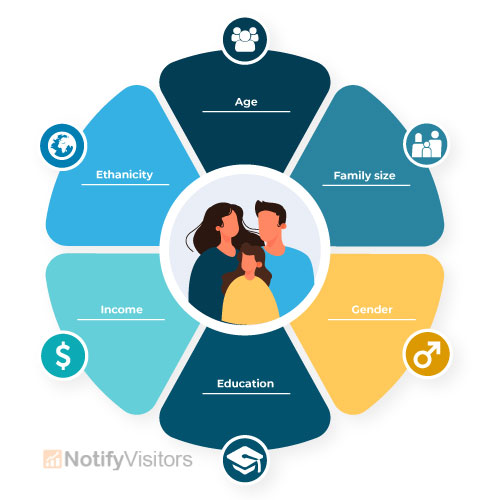
Demographic segmentation involves segmenting your market based on demographic factors such as age, gender, family size, family situation, race, ethnicity, annual income, religion, and education.
B2B businesses can segment their client firms based on their company size, industry, job role, etc. The ultimate aim of demographic segmentation is the better targetting of customers.
Types of demographic segmentation variables
Demographic segmentation is not a single variable — it is a collection of measurable attributes that marketers can combine or use independently depending on their campaign goals. Here are the most commonly used demographic segmentation variables:
1. Age
Age is the most fundamental variable in demographic segmentation. Consumer needs, preferences, and buying power change significantly across life stages — from teenagers to retirees. For example, a sportswear brand like Nike creates distinct product lines and advertising campaigns for teenagers, working adults, and seniors, each with a different message and channel.
2. Gender
Gender-based segmentation helps brands tailor products, packaging, and messaging to resonate with different audiences. Beauty and personal care brands routinely segment by gender — though modern brands increasingly use inclusive segmentation that goes beyond the binary, identifying sub-groups within each gender based on interests and lifestyle.
3. Income
Income segmentation allows businesses to align pricing, product positioning, and marketing tone with a customer’s purchasing power. Luxury brands like Rolls-Royce direct their entire marketing budget toward high-income households, while budget-friendly brands target cost-conscious segments with value messaging.
4. Education level
Education is a useful proxy for communication style and content depth. Brands selling professional software, financial products, or complex services often segment by education level to calibrate how technical or simplified their messaging needs to be.
5. Occupation and industry
Occupation-based segmentation is particularly powerful for B2B and SaaS companies. A project management tool may run separate campaigns for engineers, marketing managers, and HR leaders — each focusing on the features most relevant to that role’s daily workflows.
6. Family status and household size
Family status — whether someone is single, married, or a parent — heavily influences purchasing decisions around groceries, insurance, travel, and housing. A car brand like Volkswagen, for instance, markets its larger family vehicles specifically to households with children, emphasising safety and space rather than performance.
7. Ethnicity, religion, and nationality
These variables help multinational brands create culturally appropriate campaigns. Beauty brands, food companies, and retailers use ethnicity and religion data to ensure their products, imagery, and messaging reflect the values and norms of each audience group — especially important for holiday campaigns and regional launches.
B2B demographic (firmographic) segmentation variables
In a B2B context, demographic segmentation is often referred to as firmographic segmentation. Instead of individual traits, firms are segmented by company size (headcount or revenue), industry vertical, geographic region, ownership structure, and the seniority or function of the decision-maker being targeted. This allows B2B marketers to personalise outreach at an account level rather than a mass-market level.
Why is demographic segmentation important?
The importance of demographic segmentation can be understood by looking at the following use cases.
1. Better marketing
Brands and businesses can integrate the demographic data of their current and prospective markets into their marketing and advertising systems. This will help them in targeting each customer section better.
For instance, a clothing store can use its market’s demographic data to promote women’s clothing to female customers, men’s clothing to male customers, baby clothing to young couples with families, etc.
They can also use customer’s preferences to promote specific dresses. For example, they can promote men’s cocktail attire for male customers looking for party dresses or tweed jackets for female customers looking for formal ones.
2. Luxury targeting
Luxury brands need to ensure that they aren’t wasting their time and effort in attracting customers who won’t be able to afford their products.
Demographic segmentation helps here by helping them segment the market based on average income, and direct their marketing efforts towards only the creamy layer of the society.
3. Industrial campaigns
Industrial campaigns are those marketing or advertising campaigns that organizations run to target businesses that seek their products or services.
Demographic (firmographic) segmentation can help here by helping them target specific sectors, job designations, and job roles. This can drastically increase the campaign’s ROI. When recruiting software for specialized industrial roles, leveraging industrial recruiters enables access to passive candidates in niche engineering and technical positions. Industrial recruiters have the vertical expertise and networks to identify and engage uniquely qualified talent for industrial hiring needs.
Additionally, partnering with industrial recruiters can streamline hiring process efforts through tailored strategies and tools that integrate with HR solutions, effectively managing talent sourcing, screening, and onboarding, and ensuring a comprehensive approach to meeting industrial staffing requirements.
Implementing Workable AI screening can further streamline this process by rapidly assessing candidate qualifications through automated criteria, helping recruiters prioritize promising matches without losing time.
6 Advantages of demographic segmentation
As seen in the previous section, demographic segmentation has several use cases in marketing and advertising. Here are 6 of its benefits.
1. Easily obtainable data
One of the prime benefits of demographic segmentation is that demographic data are easily available. Businesses can pull specifics of their choice from government-maintained census data to target their customers.
For instance, builders can promote their constructions to people based on their income and whether or not they own houses.
Other than census data, you can also obtain demographic data from administrative records, registrations, lead generation forms, social media profiles, migration reports, and web surveys.
If you go for online surveys, you can distribute and collect them through different marketing channels like social media platforms, email, etc.
2. Straightforward targeting and analysis
The tool you use for market segmentation will also have analytical reporting features. You will get a detailed evaluation of your segmented data.
By going through it, you’ll get to know which segment is buying the most from you, how many people from a segment entered or exited it, which campaign performed the best, and more.
By evaluating the reason behind each metric, you’ll be able to understand what works with your audience and what doesn’t.
You can use the insights thus gained to optimize your future messaging and campaigns to increase conversion.
3. Cost-effectiveness
Segmenting your audience on the basis of their demographics doesn’t cost much. If you’re doing it using census data, it wouldn’t cost anything at all.
And even if you are using the other sources, the price wouldn’t be much. Additionally, the profit you’ll be making when compared to the price you are paying would be significantly surpassing.
For, segmentation facilitates personalizing your marketing and messaging tailored to each market segment. This in turn improves the conversions and has a favorable impact on your bottom line.
4. Customer retention and loyalty
When a business or brand caters to the specific needs of each customer segment and markets to them in a well-tailored manner, its customers become happy with it.
The customers keep coming back for its products and services. Thus, demographic segmentation acts as one of the best customer retention strategies.
Further, long-term customers, who are happy with a particular company, are likely to share it with their friends and folks.
This word-of-mouth promotion enhances your reputation in your sector and increases your customer base further.
5. Easy to measure
It is easy to assess and measure demographic data due to the simple nature of the data itself.
Demographic data is more straightforward than behavioral segmentation and psychographic segmentation, which are complex to obtain due to their subjective nature and ambiguity.
For, demographic data is only a collection of simple facts about people, and this is what makes it measurable and actionable. Additionally, it can also be easily updated.
6. Identify potential markets
Demographic segmentation also helps in identifying other potential markets. For, when you look at your analytics, you’ll be able to figure out that people with specific demographic attributes are purchasing more from you than others.
Recognizing them will show you the other markets where people who are most likely to buy your products are.
Limitations of demographic segmentation
While demographic segmentation is one of the most practical starting points for any marketing strategy, it does have notable limitations that marketers should be aware of before relying on it exclusively.
- Risk of over-generalisation: Grouping customers by a shared demographic attribute — say, age 25–34 — does not mean everyone in that group has the same motivations, values, or purchasing intent. Marketing to a demographic bracket as if it were a homogeneous audience can result in messaging that feels generic and impersonal.
- Data can go stale quickly: Demographics are not static. Income levels change with career progression, family status shifts with life events, and generational preferences evolve over time. Segments built on outdated data will misfire.
- Missing the “why” behind purchases: Demographics tell you who the customer is, but not why they buy. Two customers with identical demographic profiles may have completely different motivations and buying triggers. Without layering in behavioural or psychographic data, demographic segments can lack the depth needed for truly personalised experiences.
- Competitor overlap: Because demographic data is publicly available (census data, third-party lists), competitors often target the same demographic segments using identical variables. This makes differentiation harder unless your segmentation is combined with more proprietary data signals.
The most effective approach is to use demographic segmentation as a foundation and layer it with behavioral segmentation signals — what customers actually do, buy, and engage with — to build a richer, more actionable audience picture.
How to implement demographic segmentation in marketing
Knowing the variables is only half the picture. Here is a practical four-step process for putting demographic segmentation to work in your marketing campaigns.
Step 1: Define your objective
Before collecting any data, decide what business decision the segment will power. Are you trying to reduce churn among a specific age group? Launch a product to a new income bracket? Improve open rates on an email campaign targeting a particular occupation? A clear objective keeps your segmentation focused and avoids building segments that are interesting but not actionable.
Step 2: Collect demographic data
Pull data from the sources available to you — government census databases for broad population-level data, your CRM and purchase history for existing customers, lead generation forms and sign-up flows for first-party data, and web surveys for self-reported attributes. Enrich this with social media profile data where permitted. The more first-party data you collect directly from your customers, the more accurate your segments will be.
Step 3: Choose your variables and build your segments
Select 2–3 demographic variables that are most relevant to your objective rather than segmenting on every available attribute. For example, a financial services brand might segment by age and income; a B2B SaaS brand might segment by company size and job role. Build each segment as a distinct audience profile with a clear description of who falls into it.
Step 4: Activate — personalise messaging per segment
Once your segments are defined, tailor your messaging, creative, and channel strategy for each one. A segment of high-income 35–50-year-olds may respond better to email and LinkedIn with long-form content, while a younger income-entry segment may engage more through short-form social and push notifications. Use a customer segmentation platform to automate delivery and track performance per segment so you can continuously refine your targeting.
Final Thoughts
Demographic segmentation can play a vital role in the success of your business. So, do go for segmenting your audience on the basis of their demographics for personalized messaging and targeted marketing.
This will help you to nurture your audience easily and quickly. However, also remember that marketing solely on the basis of demographic segmentation can lead to generalization and stereotyping.
For, demographic data is quite basic. Digital marketing trends show that successful segmentation will include the needs, preferences, attitudes, interests, beliefs, online behavior, and past purchases of the consumers.
So, make sure that you segment your audience based on several categories including demographics.
The other classes should be psychographic segmentation, geographic segmentation, and behavioral segmentation. An advanced evolution of this approach is geodemographic segmentation — a method that combines geographic location data with demographic attributes to create hyper-local audience profiles, particularly useful for retailers, franchise businesses, and regional campaign planning.
Such a combination of approaches would be most useful as it can provide a qualitative and quantitative image of your target market.
Read Further:
- What is Segmentation? How Does it Work?
- Best Customer Segmentation Software & Tool
- Successful Customer Segmentation Through RFM Analysis
- What is Customer Segmentation? Definition and Type with Example
- How to Segment The Audience for Better-Targeted Marketing?
- Segmentation Statistics That You Must Know
